- Travel Information
Two Trips in One Most people who dream of Greece are actually dreaming of two different trips. One is the Greece of history books: the

Most people who dream of Greece are actually dreaming of two different trips.
One is the Greece of history books: the Acropolis, Delphi, the birthplace of democracy and the Olympic Games. The other is the Greece of postcards: whitewashed villages, blue domes, sunsets over the Aegean from a cliffside taverna.
I’ll be honest, this is one of those itineraries that makes me want to close my laptop and book a seat for myself. Sisterhood Travels’ 2027 Greece tour for women doesn’t make you choose between the two Greeces. Over sixteen days, it delivers both, moving from ancient mainland Greece into the islands without losing momentum or missing the moments that make each half of the country worth visiting in the first place.

Greece is, in a very real sense, where a lot of Western civilization’s foundational ideas began. Democracy, as a system of government, traces its roots to ancient Athens. The Olympic Games began in Olympia in 776 B.C. and ran for centuries before being revived in the modern era.
Greek mythology still shapes how much of the world tells stories today. The gods of Olympus, the oracles, the epic tales of Homer. The country’s mainland is scattered with the physical evidence of it: temples, theatres, and sanctuaries that are, in some cases, over 2,500 years old.
Greece is also a nation of islands, more than 6,000 of them, though only around 200 are inhabited. That’s part of why island-hopping has become such a defining way to experience the country.
Greek Orthodox Christianity is the dominant religion, and it shows up everywhere. Tiny whitewashed chapels on hillsides, elaborate cathedrals in major cities. Modern Greek, spoken today, descends directly from the ancient language, giving the country a rare, unbroken linguistic thread stretching back thousands of years.
The trip opens in Athens with time to settle in before diving into the city properly. A panoramic tour passes the Temple of Zeus, the Parliament building, and the site of the first modern Olympic Stadium.
Then comes the trip’s first real showstopper: the Acropolis and the Parthenon. Standing at the top, looking out over a city that’s been continuously inhabited for roughly 3,400 years, tends to reframe how travelers think about history for the rest of the trip. It’s the kind of view I imagine stops you mid-sentence.
That evening’s guided food tour through Athens’ neighborhoods adds a second layer entirely: tasting the country before diving further into its past.
From Athens, the journey heads north into some of Greece’s most visually stunning terrain. At Meteora, monasteries perched impossibly atop towering rock pillars have housed monks seeking solitude since the 14th century. It’s a sight that looks almost digitally altered until you’re standing beneath it.
Delphi follows, once considered the spiritual center of the ancient world and home to the Oracle whose prophecies were said to shape the decisions of kings. The Sanctuary of Apollo, the ancient theatre, and the site museum bring that history into focus before the trip winds down for the evening in the charming mountain town of Arachova.
The mainland leg continues into the Peloponnese, with a stop at a local farm for a taste of rural Greek life before reaching Olympia, the birthplace of the Olympic Games. Here, the group walks the original stadium track used in 776 B.C.
A hands-on Mediterranean cooking class and an evening of traditional Greek dance add real texture here. From there, the trip winds through the Arkadian Mountains to a family-run ouzo distillery that’s been crafting Greece’s signature spirit since 1869.
A choice-your-adventure day follows in Nafplio, Greece’s elegant first capital. Travelers can either explore the ancient site of Mycenae, home of the legendary King Agamemnon, the Lion Gate, and the Beehive Tombs, or stay in town for a slower walking tour of its Venetian architecture and seaside charm.

The trip’s second half shifts entirely in character with a high-speed ferry to Mykonos, the whitewashed jewel of the Cyclades. Chora, the island’s old town, delivers exactly the scene most people picture when they imagine Greece: narrow lanes, bright white buildings, pops of blue, and a genuinely lively energy day and night.
A day trip to the nearby island of Delos adds a dose of ancient history back into the island portion of the trip. It’s a UNESCO World Heritage Site and, according to legend, the birthplace of Apollo and Artemis, with ruins including the House of Dionysus and its intricate mosaics and the iconic row of Naxian Lion statues.
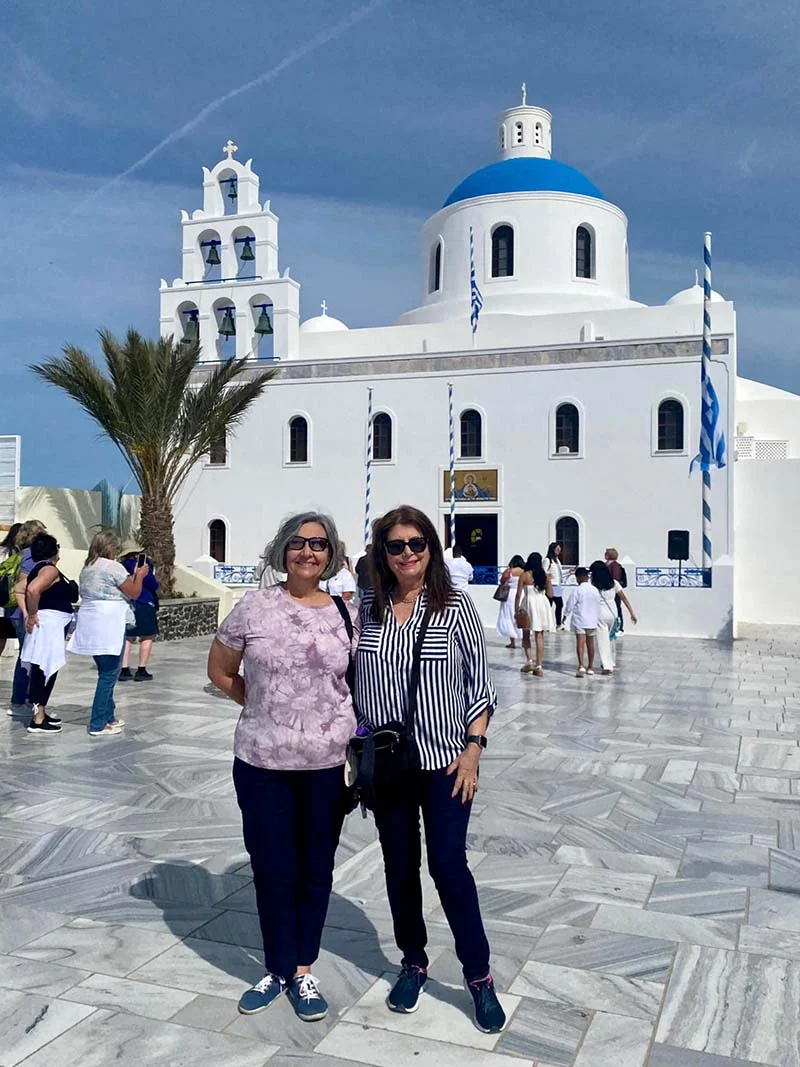
From Mykonos, the trip continues to Santorini, arguably the most photographed island in Greece, and for good reason. The village of Oia delivers the caldera views the island is famous for: white buildings cascading down dramatic volcanic cliffs above deep blue water. This is the postcard I’d want to send myself.
Beyond the postcard views, the trip digs into Santorini’s deeper history at Akrotiri, a remarkably preserved prehistoric settlement often called the “Minoan Pompeii” for how completely it was preserved beneath volcanic ash.
A local winery tasting and a visit to the quiet, centuries-old village of Megalochori round out the island days before the group flies back to Athens for one final evening together.
This trip is rated Busy, and the itinerary backs that up. Expect extended walking tours, several full touring days, and some genuinely demanding stretches of terrain.
The Acropolis alone requires climbing roughly 50 to 60 steep, uneven steps without railings. Meteora’s monasteries involve about 135 steps, and visitors must have their shoulders and knees covered (skirts, dresses, or a scarf for pants) or they won’t be permitted inside.
The walk on Delos covers close to a mile in open sun with little shade. And the ferry transfers between Athens, Mykonos, and Santorini require carrying your own luggage roughly 200 feet at each port, often through crowded, fast-moving terminals.
None of this should be discouraging so much as clarifying. This is an active, immersive trip best suited for women who are comfortable on their feet for extended periods and steady navigating uneven, historic terrain. As with all Sisterhood trips, it cannot accommodate wheelchairs, walkers, or other mobility devices
Is this trip better suited to history lovers or beach lovers?
Both, genuinely. The first half is built around ancient sites — Athens, Meteora, Delphi, Olympia — while the second half shifts fully into island life on Mykonos and Santorini. Few itineraries balance the two this evenly.
How physically demanding is this trip?
It’s rated Busy. Expect extended walking tours, some challenging terrain including steep, uneven steps at the Acropolis and Meteora, and ferry transfers that require carrying your own luggage a short distance. Travelers should be comfortable staying active most days.
Is there a dress code for any of the sites?
Yes — the monasteries at Meteora require shoulders and knees to be covered. Bring a scarf or lightweight wrap if you’re wearing pants, or plan to wear a longer skirt or dress that day.
What’s the best part of visiting the Greek islands versus the mainland?
They offer very different experiences. The mainland is where Greece’s ancient history lives — temples, oracles, and Olympic origins. The islands, particularly Mykonos and Santorini, offer that iconic whitewashed, caldera-view Greece most travelers picture, along with a noticeably slower, more relaxed pace.
Do I need a visa to travel to Greece in 2027?
Travelers from the U.S. will need an ETIAS tourist visa for travel within the European Union, effective from the fourth quarter of 2026. Applications aren’t yet open, but Sisterhood Travels will notify travelers when it’s time to apply.
Between the Parthenon and the caldera views of Oia, most Greece itineraries pick a lane. This one doesn’t have to — sixteen days is enough time to stand in the footsteps of ancient philosophers and still catch a sunset over the Aegean with a glass of local wine in hand.
Bookings close November 28, 2026, after which the trip moves to a waitlist. Explore the full itinerary: Discover Greece — Mykonos & Santorini 2027.