- Travel Information
There’s a particular kind of trip that people put off for years — not because they don’t want it, but because it feels too big

There’s a particular kind of trip that people put off for years — not because they don’t want it, but because it feels too big to figure out alone. Peru tends to fall into that category. Between the altitude, the internal flights, the language, and a bucket-list site that requires real planning just to visit responsibly, it’s easy to let “someday” become “maybe never.” Sisterhood Travels’ Peru Tour for women in June 2027 removes almost every one of those obstacles, and what’s left is eleven days that live up to everything Peru promises.
Peru is one of the cradles of civilization in the Americas. It’s home to the Inca Empire, which at its height in the 15th and 16th centuries stretched along the spine of the Andes from modern-day Ecuador to Chile.
Long before the Incas, other cultures left behind their own extraordinary art and architecture. The Moche, the Nazca, and the Chavín are among them, and much of what they built is still being studied today.
Peru’s official languages include Spanish, Quechua, and Aymara. Quechua in particular remains widely spoken across the highlands, a living link to the Inca world.
The country is also home to an astonishing range of geography packed into one nation. Desert coastline, high Andean peaks, and Amazon rainforest all sit within a few hours of each other.
Peruvian cuisine has become one of the most celebrated food cultures in the world, built on ingredients like potatoes (Peru is home to thousands of native varieties), corn, and fresh seafood from the Pacific. This trip leans into that at nearly every stop.
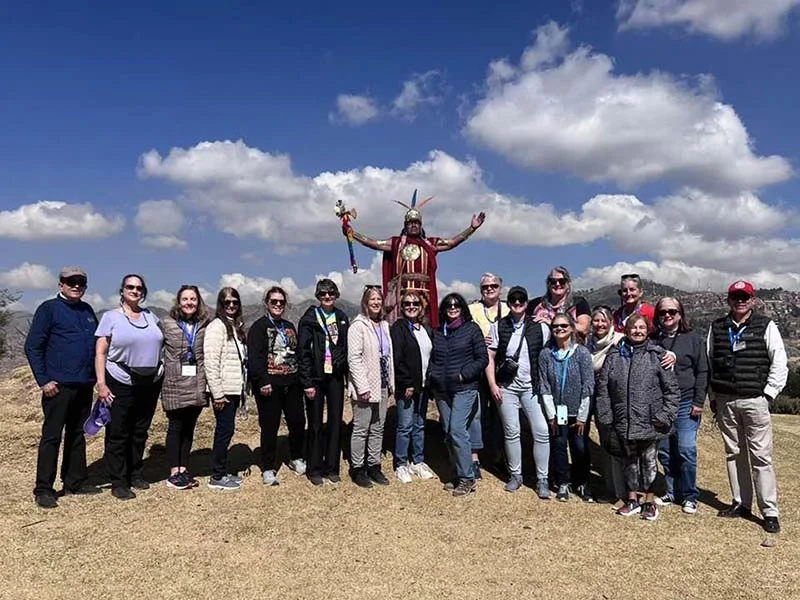
The trip begins gently, with two easy days in Lima before the pace picks up. That’s intentional. Lima sits at sea level, and the days ahead climb into thin Andean air.
Lima’s historic center is a UNESCO World Heritage Site in its own right, and the trip spends real time there. Highlights include the Cathedral at Plaza de Armas, the San Francisco Monastery and its centuries-old catacombs, and the Casa de Aliaga, a private colonial home that’s remained in the same family for generations, offering a rare glimpse into Lima’s layered history.
A Welcome Dinner of Peruvian cuisine kicks off the trip properly, setting the tone for a country whose food culture is every bit as central to the experience as its ruins.
From Lima, the group flies to Cuzco and continues into the Sacred Valley, the fertile heart of the old Inca Empire. Along the way, the vibrant handicraft market at Pisac offers a first taste of Andean craftsmanship.
The ruins at Ollantaytambo, with their massive terraced stonework, are among the best-preserved Inca sites anywhere in Peru. A visit to the Pablo Seminario Ceramic Studio shows how that same tradition of craft continues today.
A day spent with a local Andean community brings the trip’s most personal moment: hands-on time with traditional weaving and farming, a lesson in local dance, and a farm-to-table lunch prepared by the community itself. This is Peru not as a backdrop, but as a place still very much lived in.
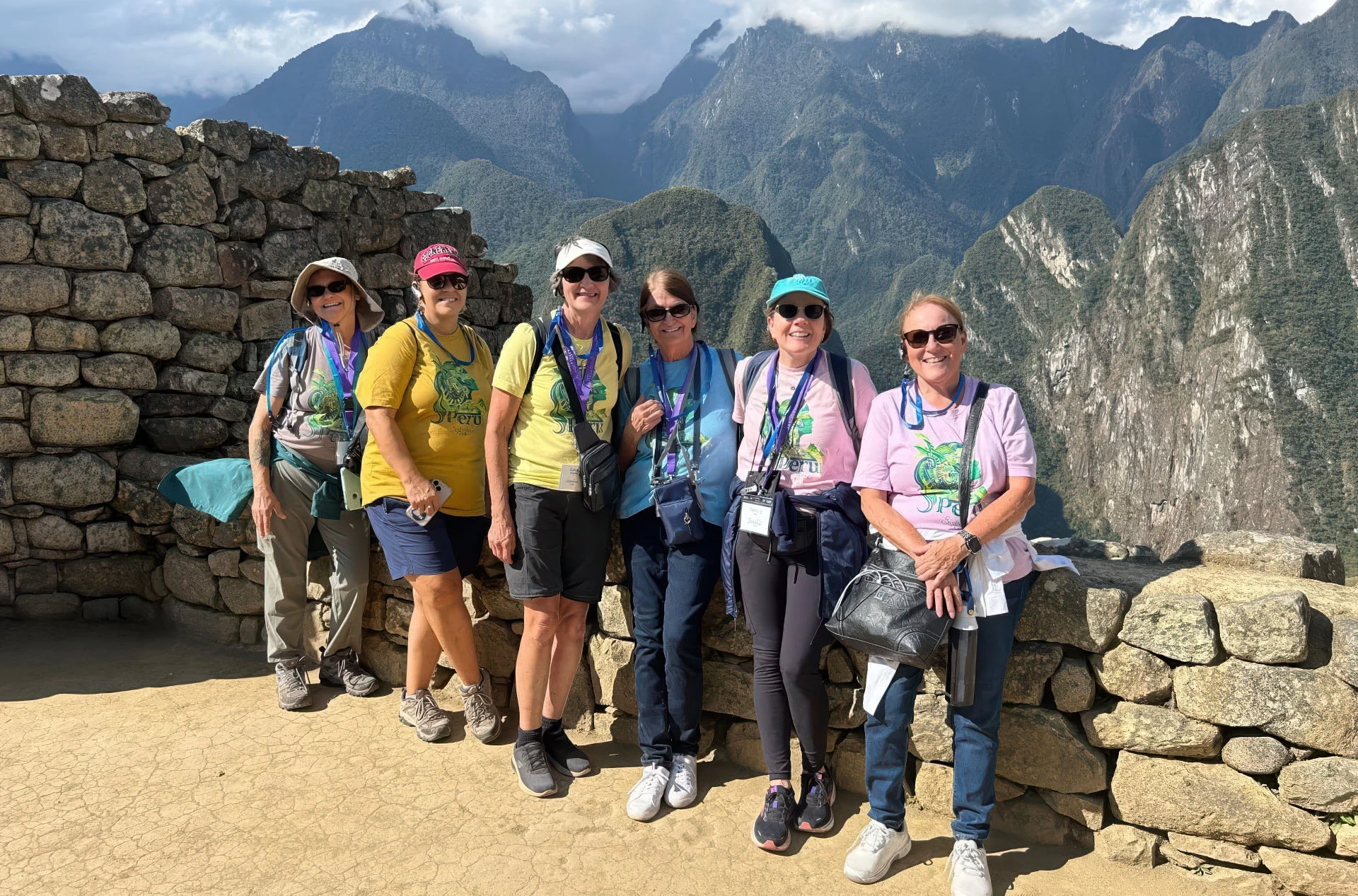
The centerpiece of the trip is Machu Picchu. Sisterhood Travels builds in something most visitors never get: two separate visits.
The first comes after a scenic train ride through the Andes, arriving at the citadel in the afternoon with a guide to unpack its history and its mysteries. How it was built, why it was abandoned, and how it stayed hidden from the outside world for centuries.
The group stays overnight at the base of the mountain, which makes the second visit possible. An early return the next morning, before the crowds arrive, when the ruins feel almost private and the light moves differently across the stone terraces.
It’s a rare kind of gift on a group tour: permission to slow down at exactly the moment most people are being rushed through.
That evening also brings one of the trip’s most fun stops. A hands-on class in Peruvian cooking, learning to make fresh ceviche and the perfect pisco sour before sitting down to enjoy what the group has made.
Back in Cuzco, the trip explores the city properly. Stops include the lively San Pedro Market, the Inca temple of Koricancha, the Plaza de Armas, and Cuzco Cathedral, with the choice of climbing to the hilltop ruins of Sacsayhuamán or exploring the city’s quieter, more local streets.
From there, the journey continues to Puno, on the shores of Lake Titicaca, the legendary birthplace of the Inca Empire. At roughly 12,500 feet, it’s one of the highest navigable lakes in the world.
Lake Titicaca is where this trip becomes truly unforgettable. The floating islands of the Uros people are built entirely from woven totora reeds, a tradition stretching back generations. They’re unlike anything else on the itinerary, and walking across one is genuinely disorienting in the best way.
A home-hosted meal in a rural lakeside village and a stop at the ancient funerary towers of Sillustani add even more depth to a day that already feels like stepping into a different century.
The journey closes back in Lima, with a visit to the Larco Museum, an extraordinary collection of pre-Columbian art and artifacts housed in a restored colonial mansion. A Farewell Dinner on the museum grounds follows before flights home.
This is Sisterhood’s most physically demanding destination trip, rated Busy rather than Moderate, and that distinction matters. The itinerary includes three internal group flights, a train journey to Machu Picchu, and multiple early morning departures.
Expect extended walking, often three or more hours at a stretch, across uneven stone pathways and archaeological sites without handrails. Hotels outside Lima are typically small properties without elevators, so expect 10 to 15 steps to reach most rooms.
Altitude is the other major factor. Several days of this trip are spent around 11,000 feet, with the highest point in Puno reaching approximately 12,500 feet.
Altitude sickness (headache, fatigue, nausea, dizziness) is a real possibility even for travelers in good health. Anyone with underlying health concerns should talk to their doctor before booking.
Most hotels on this route keep oxygen on hand for guests who need it. But this is a trip that rewards being upfront with yourself about your fitness level before you go, not after you’ve landed in Cuzco.
As with all of Sisterhood’s trips, this one cannot accommodate wheelchairs, walkers, or other mobility devices. Travelers should be able to walk independently across varied and sometimes challenging terrain

Is Peru safe for women traveling without a partner?
Yes, especially as part of a guided group. Between the altitude, the internal flights, and the logistics of visiting Machu Picchu, this is exactly the kind of trip where traveling with an experienced group makes the difference between a stressful solo attempt and a smooth, well-supported journey.
How worried should I be about altitude sickness?
It’s worth taking seriously. Several days of this trip take place at 11,000 feet or higher, and symptoms like headache, fatigue, or nausea are common even for healthy travelers. Talk to your doctor before you go, especially if you have any cardiac or respiratory conditions, and know that most hotels along the route have oxygen available.
Why does the trip visit Machu Picchu twice?
Staying overnight at the base of the mountain allows for an early return the following morning, before the bulk of the day’s visitors arrive — a quieter, more personal experience of a site that can otherwise feel crowded and rushed.
How physically demanding is this trip compared to Sisterhood’s other tours?
This is rated Busy, one level up from Moderate. Expect extended walking on uneven terrain, hotels without elevators outside Lima, and a fast-moving itinerary with several early departures. It’s best suited for travelers who are active and comfortable with a demanding pace.
What makes Lake Titicaca worth the trip?
Beyond its striking high-altitude setting, Lake Titicaca is home to the Uros people’s floating islands, built entirely of woven reeds — a living tradition found nowhere else in the world, and one of the most distinctive cultural experiences in South America.
Peru isn’t a place you stumble into casually, and that’s part of what makes it special. This is a trip for women who are ready for it — ready for the altitude, the early mornings, and the long days — and who want Machu Picchu and Lake Titicaca to be more than a photo they’ve seen a thousand times before.
Bookings for this trip close November 1, 2026, after which it moves to a waitlist. Explore the full itinerary: Peru Uncovered — Machu Picchu & Lake Titicaca 2027.


 Sisters in Hawaii
Four islands. 14 days. One incredible Sisterhood